Chiropractor West Palm Beach: Pediatric Auto Injury Recovery

From Dr. Natalie Meiri’s Clinical Pearl Stories: West Palm Beach Chiropractor: Pediatric Auto Injury Recovery


This was a 30 year old mother and her 4 year old son who were involved in a motor vehicle accident. The chief complaints were neck, back and extremity (arms and legs) injuries.  They presented to my office 1 day after sustaining injuries from a car accident. Their car was hit on the passenger side.  That was the side the baby was in. To be HIPAA compliant, I will call the mother Karina and the son Adam instead of their real names.  Karina was a long time patient of my office and knew the benefits of chiropractic.  Karina knew chiropractic physicians examined, diagnosed and treated neuromusculoskeletal conditions. Moreover, chiropractic care after a car accident can get you out of pain naturally.  After all, pain medications can be harmful and addictive for both adults and kids.


Examination and X-rays

Upon examination, I found positive tests for a sprain diagnosis for all of Karina’s injuries (neck, back and right wrist).  Similarly, upon examination, Adam also had a sprain diagnosis for all his injuries (neck, back, chest and abdomen). They had suffered a whiplash injury (injury due to forceful, rapid back-and-forth movement). And they both had tenderness where their seat belts were. Even though the baby couldn’t speak, he had difficulty doing his regular motions and especially in lifting his legs.  Subsequently, the baby went to the pediatrician who cleared him for chiropractic care.

The x-rays taken at the imaging center showed mild osteoarthritis in Karina’s right wrist, cervical (neck), thoracic (mid back) and lumbar (low back) spine. This is the “wear and tear” type of arthritis. Furthermore, the x-rays showed instability in the neck and spine during the whiplash. Two of her vertebrae in her neck had ligamentous instability (stretched or tiny torn soft tissues, but not ruptured) from this accident. So the osteoarthritis was solely a finding on the imaging that had occurred over the years. Karina had decreased cervical lordosis (decreased normal curve in the neck) consistent with cervical myospasm (muscle spasm) on her cervical x-ray. I would order an MRI (magnetic resonance imaging) if there was no improvement after 12 visits.


Chiropractic Treatment

Starting at 3-4 times a week for the mom and 2-3 times for the baby, it took many months of care. Firstly, treatments included chiropractic adjustments/ manipulation.  Secondly, soft tissue therapy (myofascial release, pressure point and various neuromusculoskeletal re-education procedures).  Thirdly, modalities (cold/heat therapy and electric muscle stimulation) were administered as needed for Karina’s injuries. Finally, therapeutic exercises to continue treatment at home were given. 

Both Karina and Adam started to feel better from the first week of treatment.  After months of treatment, their conditions were stable enough to return for care as needed.

 

What are some auto accident injury symptoms?

  • Neck pain from whiplash. The pain can range from mild to severe. It might be  in one spot, a general area, or radiate down the shoulder into the arm and/or hand. This can be caused by ligament sprains or muscle strains, but also by injuries to discs, nerves, joints, and/or bones.
  • Neck stiffness or reduced range of motion. Reduced neck mobility could be from pain, irritation of the cervical facet joints, or spasm of the cervical muscles.
  • Headache. This could be from neck muscle tightening/spasm.  Also, a nerve or joint irritation of the spine could cause headaches.
  • Neck instability. This whiplash symptom commonly results from stretched or torn soft tissues, such as ligaments. Although, it could also be caused by a fracture.
  • Back and extremity (arms and legs) pain. Your back can also suffer whiplash (acceleration/deceleration injuries) during an auto accident. Subsequently, your back can refer pain to other soft tissues in the upper back and shoulders or legs. Of course, you can also separately sprain or strain your extremity as well during the collision. 

Adults and kids respond well to chiropractic care after whiplash

First, for some people, whiplash symptoms can be minor. For others, the symptoms can become varied and chronic, ranging from severe pain to cognitive and emotional problems.  Some patients often complain of other symptoms and signs such as blackouts, visual disturbances, nausea and vomiting, and chest pain.  Also, a nondermatomal pattern (a large area of sensory finding) of pain and deficit is common.

Second, sometimes whiplash symptoms persist or get worse with time. Whiplash symptoms might manifest immediately following the acceleration-deceleration accident, or they can take a few hours or days to appear. Even low-speed rear impact injury crashes (LOSRIC) account for as much as 80% of rear impact collisions. The range of speed in these types of crashes are between 6 and 12 mph.

Third, results from a study showed an association between a history of neck injury in a motor vehicle accident and chronic headaches, disabling neck pain, and a perception of  lower general health compared to those with no history of neck injury. This is why it is so important to get care right away. The good news is, recent encouraging research indicates that patients with symptoms of whiplash injury respond well to chiropractic care!


Safety of Chiropractic for Kids

The American Chiropractic Association cites a study done in 2014 confirming that chiropractic adjustments are overwhelmingly safe in infants and children.

In 2009, a survey found that there were about 68 million pediatric visits to chiropractors. The National Board of Chiropractic Examiners’ most recent practice analysis, issued in 2010, found that about 17 percent of chiropractic patients were under age 18 — approximately 7.7 percent aged five years or younger and some 9.4 percent between ages six and 17.
 

Dr. Natalie Meiri
Dr. Natalie Meiri
West Palm Beach Chiropractor: Pediatric Auto Injury Recovery

The fact is Chiropractors receive training to treat all people, from babies to the elderly.  And many children have benefited from chiropractic care, including babies. Moreover, Chiropractic care is among the most common complementary and integrative health care practices used by children in the United States (US National Center for Health Statistics Report, 2015) and internationally. So children with musculoskeletal conditions often seek chiropractic treatment.  Specific issues include musculoskeletal/neurologic development, sports injuries and also injuries sustained in an motor vehicle accident.  For parents who are looking for answers besides putting their kids on more drugs, Chiropractic is a great solution.

Meiri Chiropractic offers chiropractic treatment for car accident injuries and other ailments for adults and kids. Call 561-253-8984 to schedule an appointment!



West Palm Beach Chiropractor: 3 Common Shoulder Conditions Acupuncture Can Treat

There are so many benefits to trying acupuncture for your shoulder pain.  By seeing a chiropractor who is also certified in acupuncture, you can treat a wide range of health issues without the side effects of prescription medication. And this includes your shoulder pain. Read below to find out about West Palm Beach Chiropractor: 3 Common Shoulder Conditions Acupuncture Can Treat.

Shoulder Pain and Acupuncture

Firstly, shoulder pain encompasses both joint and muscular pain. Most commonly, shoulder pain is caused by periarthritis of the scapula and humerus, shoulder fasciitis, rotator cuff injuries, and acromial impingement syndrome.

Secondly, acupuncture can be used alone or in conjunction with chiropractic care to manage pain. Indeed, it is an ideal adjunct to chiropractic care.  Acupuncture is a centuries-old healing procedure which focuses on the integrity of bodily systems and nonspecific conditions.  It is a form of holistic healing. And it can be used to treat arthritis, tendinitis, GI disorders, anxiety, musculoskeletal conditions, and acute/ chronic pain among others.

Thirdly, Acupuncture can help reduce inflammation in the body. It can help with a wide range of inflammatory conditions.  This includes acute inflammation from sports injuries or falls, to autoimmune disorders, and chronic inflammatory conditions. Scientists are researching how acupuncture reduces inflammation in the body. Simply put, acupuncture releases muscle tightness, improves circulation, and activates your natural opioids that help reduce pain. Acupuncture is said to alter physiological processes in the body via the brain and nervous system.

1) Acupuncture is Effective for a Rotator cuff sprain and strain

The rotator cuff is a group of muscles (supraspinatus, infraspinatus, teres minor, subscapularis) that hold the shoulder joint in place and allow you to move your shoulder. And a sprain is a sudden or violent twisting injury of a joint with stretching or tearing of ligaments. Symptoms can be joint swelling, bruising, and instability. And a strain occurs when a muscle is overstretched or torn. This usually occurs as a result of fatigue, overuse, or improper use. Furthermore, damage to your attached tendons can also occur with a strain. Symptoms include muscle pain, spasms, weakness, and cramping. Moreover, both a strain and/or sprain can cause pain, tenderness, and limited motion in the affected area.

One study assessed Acupuncture-movement therapy for a lumbar sprain.  Typically, this combines traditional needle insertion with active or passive physical movement while the needles are left in the body. The conclusion was that Acupuncture-movement therapy is effective for treating acute lumbar sprain.  Moreover this included relief of persistent pain and improvement of lumbar mobility. Therefore, Movement, lumbar exercise during acupuncture, enhances the effect of acupuncture.  The study began by saying there are studies on the effectiveness of acupuncture for an acute lumbar sprain. And this study focused on the improvement of lumbar via Acupuncture-Movement therapy.

2) Acupuncture is Effective for Shoulder impingement syndrome

A shoulder impingement syndrome is defined as a compromise of the space between the coracoacromial arch (portion of top outer edge of shoulder blade) and the proximal (situated nearer the center of the body) humerus (upper arm bone). So several structures may get impinged (pinched): The biceps tendon, superior labrum (cartilage in shoulder joint), supraspinatus (1 of the rotator cuff muscles) tendon, and the subacromial bursa (a fluid-filled sac for countering friction at a joint ) are all vulnerable to being impinged.

Causes for shoulder impingement include both structural and functional reasons:

Structural reasons:

-variant acromial types that are hooked or lengthened (top portion of shoulder blade developed/grew abnormal)

-degenerative (wear and tear arthritic) changes on the undersurface of the acromion

-an inflammatory process in the subacromial space (which could be due to i.e. bursitis, rotator cuff tear, or/and all of the above)

Functional reasons:

-abnormal position of your spine or scapula (ie. thoracic kyphosis)

-tightness of your shoulder capsule (membrane around shoulder joint),

-decrease in the space between the coracoaromial arch and proximal humerus due to past injuries

-abnormal motion due to nerve related problems (i.e. nerve palsy)

Research on Acupuncture:

A study was done to “decrease the intensity of short- and mid-term pain in the injured shoulder by means of acupuncture” (2). This study concluded acupuncture to treat impingement syndrome was effective.  Additionally, acupuncture was found to be a safe. Acupuncture was deemed to be a reliable option for shoulder impingement therapies.


3)  Acupuncture is Effective for Thoracic Outlet Syndrome (TOS)

The term “thoracic outlet” is the area between the neck and shoulder, over the top of the thorax (chest), and under the clavicle (collar bone). It is a space in the lower neck between the thorax and axilla (armpit) through which the subclavian vein, subclavian artery, and brachial plexus (network of nerves that provides movement and feeling to the shoulder, arm and hand) travel.

Compression at the thoracic outlet can involve the brachial plexus, subclavian artery, or subclavian vein at various sites as they travel downward into the arm.  Several common sites are possible for compression: cervical rib, scalene triangle, Subcoracoid Space, Costoclavicular Space.

Symptoms of TOS:

You may have diffuse (spread out) arm symptoms, including numbness and tingling. Often, you may describe the pain taking a path down the inside of your arm to the little and ring fingers. Moreover, when you do any overhead activity it is often made worse. For example, overhead throwing, serving a tennis ball, and painting a ceiling may exacerbate symptoms. Frequently, you may have weakness radiating from the neck and shoulder and extending into the arm and hand.  Even driving and typing may sometimes be difficult.

Causes of TOS:

There are many causes of Thoracic Outlet Syndrome. Firstly, compression may be due to physical trauma such as from a car accident or a sports injury. Secondly, anatomical defects from birth may show symptoms later in life. Thirdly, tumors that press on nerves, though rare, are possible. Fourthly, the changes of pregnancy (e.g. postural, hormonal, swelling) may lead to Thoracic Outlet Syndrome.  Lastly, poor posture such as a forward head carriage and rounded shoulders can lead to compression. And repetitive arm and shoulder movements and activity, such as from playing certain sports also are a potential culprit. These overuse injuries can lead to swelling and fibrosis causing compression of the nerves and vessels.

Nerve conduction studies or imaging (x-ray) studies to confirm or rule out a diagnosis of Thoracic Outlet Syndrome maybe recommended.

Research on Acupuncture:

A study conducted in South Korea was based on a case of a 29-year-old male patient.  They were diagnosed with thoracic outlet syndrome and admitted into the hospital. The patient had left shoulder pain and arm numbness. The pain was worse if it had become cold. Treatment consisted of acupuncture, herbal medicine and physical therapy.  After 3 weeks of this integrated approach, the patient found relief.  This case suggested an integrated approach which included acupuncture resulted in an excellent outcome for TOS.  

Dr. Natalie Meiri
Dr. Natalie Meiri

West Palm Beach Chiropractor: 3 Common Shoulder Conditions Acupuncture Can Treat

Meiri Chiropractic in West Palm Beach offers Acupuncture for the shoulder and many other ailments. Schedule an appointment for chiropractic, acupuncture or both by calling 561-253-8984 today.


References:

1) A Case Report of Thoracic Outlet Syndrome Improved by Integrated Korean Medical Treatment

https://www.e-jar.org/journal/view.html?uid=2144&vmd=Full

2). Acupuncture treatment of shoulder impingement syndrome: A randomized controlled trial

https://pubmed.ncbi.nlm.nih.gov/27062955/

3) Acupuncture-movement therapy for acute lumbar sprain: a randomized controlled clinical trial, Journal of Traditional Chinese Medicine

 https://www.sciencedirect.com/science/article/pii/S0254627216300036


West Palm Beach Chiropractic: Relief from Chronic Pelvic Pain with Acupuncture


Chronic pelvic pain syndrome is described as pain that lasts in the pelvis for more than 6 months. Also, it can occur as episodes lasting more than 3 months.  It affects up to 15% to 26% of females, but effects 10-15% of males. Chronic pelvic pain is rarely caused by just one issue. It is multifactorial and involves many conditions. Indeed, Chronic pelvic pain syndrome is a difficult condition that adversely affects patients’ health and quality of life.  Read on to find out how you can find Relief from Chronic Pelvic Pain with Acupuncture.


What are Some Symptoms and What Causes Chronic Pelvic Pain (CPP)?

It presents as pelvic pain, abdominal pain, or low back and hip pain.  The pain may be described as burning, stabbing pain, numbness, or tingling in the lower abdomen, hip and groin.

Other common symptoms include:

-Persistent or recurring dull ache, pressure, or sharp pain below the belly button

-Pain or discomfort during urination or sexual intercourse

-Urinary urgency, frequency, or bowel irregularities


The etiology (cause) of CPP is unknown and unclear.  CPP overlaps with gynecologic, gastrointestinal, musculoskeletal and psychosocial/central problems. And it could be a combination of the following:

Musculoskeletal/ Neurological: Pelvic floor muscle spasms, tension, neuropathy or pelvic girdle pain.

Gynecologic: Endometriosis, uterine fibroids, dyspareunia (persistent or recurrent genital area or pelvic pain) and dysmenorrhea (painful menstrual periods or severe menstrual cramps)

Urologic: Painful bladder syndrome (interstitial cystitis) or recurrent urinary tract issues.

Gastrointestinal: Irritable bowel syndrome (IBS) or inflammatory bowel disease. 

Psychosocial/Central: Central nervous system hypersensitivity, chronic stress, depression, or a history of trauma/abuse.


How Can Acupuncture Help Chronic Pelvic Pain (CPP)?

Firstly, treating CPP with Alternative or complementary therapies have been used increasingly worldwide.  This is especially true for musculoskeletal related CPP. And acupuncture has been shown to be well-tolerated and safe.

Secondly, CPP typically requires a multidisciplinary approach.  The specialists are various (e.g. primary care, gynecology, urology, acupuncture) to find the correct diagnosis and treatment. Indeed, there are many causes of CPP, including anatomical, functional, degenerative, organic and other different causes. However, many studies reveal that acupuncture treatments can typically alleviate the pain of CPP with different etiologies.

Third, research suggests acupuncture works by improving blood circulation and stimulating the nervous system.  And the release of natural analgesics (e.g. endorphins) following acupuncture is documented. Additionally, acupuncture helps regulate pelvic floor muscle dysfunction and immune/inflammatory factors.


Myofascial Pelvis Pain and Acupuncture Research Studies

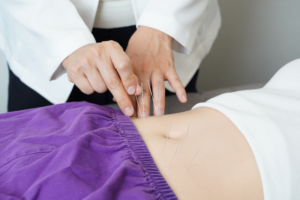
In one study, the efficacy of acupuncture for Chronic Pelvic Pain due to abdominal myofascial pain syndrome was assessed.  Furthermore, the participants in the study were unresponsive to treatment with trigger-point injection. Subsequently, acupuncture treatments were targeted at abdominal-wall trigger points once per week.  And following acupuncture treatment for 10 consecutive weeks, the participants found relief.

In another Chronic Pelvic Pain paper, the author looked at myofascial pelvic pain and its treatment using a “Western acupuncture ” rather than a traditional Chinese medicine approach. Specifically, the deactivation of trigger points within the abdominal wall, pelvic basin and hip were explored. Acupuncture from the traditional Chinese approach classifies trigger points as ashi points. The study stated, research states  acupuncture can be beneficial in this process of releasing ashi points.  For instance, Travell et al (1952) reported that needling tender Trigger points resulted in significant pain relief. 


West Palm Beach Chiropractic: Relief from Chronic Pelvic Pain with Acupuncture

In another study, the researchers concluded, acupuncture effectively helped Chronic pelvic pain patients on their pain management. Interestingly, this included various methods of acupuncture (e.g., moxibustion, abdominal acupuncture, ear acupuncture). The study actually found acupuncture alone was more effective.  They concluded, Acupuncture may be especially advantageous for patients who are intolerant to conventional drugs.  Also, many patients have a Comorbidity (e.g. coexisting condition) that keeps them from utilizing standard medical interventions.


Dr. Natalie Meiri
Dr. Natalie Meiri


West Palm Beach Chiropractic: Relief from Chronic Pelvic Pain with Acupuncture

Acupuncture has been used for over 4000 years.   Acupuncture effects what the ancient chinese practitioners called Meridians (energy channels) in your body under the skin. Traditional acupuncture is based on the belief that an energy, or “life force”, flows through the body in these channels called meridians.

Today, Researchers believe when an acupuncture stimulates the nerves. This sends a message to your brain and nervous system. Ultimately, Acupuncture improves blood flow and calms the nervous system.  This triggers nerve signaling that affects the function of other parts of the body, including organs.

Dr. Natalie Meiri is a chiropractic physician, board certified in acupuncture with over 20 years of experience.  Call 561-253-8984 today!  Ask to make an appointment or find out more about: West Palm Beach Chiropractic: Relief from Chronic Pelvic Pain with Acupuncture.


References:

  1. https://pmc.ncbi.nlm.nih.gov/articles/PMC10695139/

J Pain Res. 2023 Nov 30;16:4049–4069. doi: 10.2147/JPR.S434333

Research Trends of Acupuncture Therapy on Chronic Pelvic Pain Syndrome from 2000 to 2022: A Bibliometric Analysis


     2. https://pmc.ncbi.nlm.nih.gov/articles/PMC5733650/

Med Acupunct. 2017 Dec 1;29(6):397–404. doi: 10.1089/acu.2017.1248

Effect of Acupuncture on Chronic Pelvic Pain Secondary to Abdominal Myofascial Syndrome. Not Responsive to Local Anesthetic Block: A Pilot Study


    3. https://www.journalofchinesemedicine.com/the-treatment-of-pelvic-pain-with-acupuncture-part-1.html

The Treatment of Pelvic Pain with Acupuncture: Part 1 By Jennie Longbottom