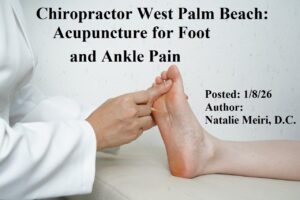
Chiropractor West Palm Beach: Acupuncture for Foot and Ankle Pain


This post is about Chiropractor West Palm Beach: Acupuncture for Foot and Ankle Pain. On the basis of the existing evidence, acupuncture can be a helpful complementary treatment for foot and ankle pain.  Foot and ankle pain can significantly alter your quality of life.  It effects your mobility and daily activities. Are you seeking a holistic natural approach to pain relief and better mobility? Acupuncture may be your solution.

Studies suggest acupuncture can reduce the frequency and severity of foot pain, and may offer longer-lasting relief than some medications. It’s also safe and cost effective. Lastly, it doesn’t have the side effects as some medications do.  While not a cure, it can be a valuable option for those seeking alternatives or in conjunction with their foot/ankle management.

Problems in the Feet

Most foot complaints are due to lack of proper support or inappropriate footwear. Ill-fitting or irritating shoes is a culprit. It may result in corns or calluses, sesamoiditis (inflammation of the sesamoid bones in the ball of the foot and the tendons they are embedded in) or aggravation of hallux valgus (bunion) at the first toe, or fat pad syndrome at the heel . Moreover, tight-fitting shoes may also cause compression of metatarsals (5 forefoot bones).

Also, if the foot is too mobile (i.e., hyperpronated), there may be a lack of support.  This may cause plantar fasciitis and strain of the tibialis posterior muscle (deep calf muscle). Indeed, proper shoes are important.  And if you have any forefoot (front of foot) or hind foot (back of foot) abnormalities (i.e. varus or valgus) you are more likely to strain your feet.  


Complicating Factors

Firstly, as the furthest part of your body, your foot is commonly affected by vascular disorders. Arterial occlusive (inadequate blood flow due to narrowing of the arteries) disorders block blood flow. Valvular insufficiency in veins along with gravity may lead to vascular stasis (veins can’t send blood back to heart).

Secondly, neurologic dysfunction associated with metabolic neuropathies can occur.  For instance, as seen with diabetic neuropathy.

Thirdly, being bare footed may lead to trauma. In contrast, the supported foot is susceptible to the pressure effects and biomechanical alterations of footwear. Especially if you are diabetic this can lead to unnoticed and untreated problems due to sensory deficits (i.e. touch, temperature, pain and other sensations).

Common Conditions of the Foot and Ankle

Some common conditions involving the foot and ankle that are biomechanical in nature include the following:

  1. First toe-hallux valgus/rigidus (stiff first toe), turf toe (sprain to the main joint of the big toe), and sesamoiditis
  2. Metatarsalgia (pain and inflammation in the ball of your foot)
  3. Peroneal tendinitis (inflammation in the tendons that run along your outer ankle/foot)
  4. Plantar fasciitis (inflammation of fascia tissue on the bottom of your feet)
  5. Achilles tendon/heel-tendinitis, bursitis (painful inflammation of small, fluid-filled sacs that cushion the bones, tendons and muscles near your joints) and fat pad syndrome
  6. Neuropathy

In addition to the above, ankle inversion and eversion sprains are very common. The most common are plantar flexion/inversion (foot turned inward) sprains. Also, chronic ankle pain and/or instability is not uncommon following repeated ankle sprains.

It is important not only to treat the acute injury, but also to prevent future occurrences. This often entails evaluation of the activity or sport coupled with a post injury rehabilitation program.


Chiropractor West Palm Beach: Acupuncture for Foot and Ankle Pain: Research

n one study, the efficacy of acupuncture on foot and ankle disorders for pain intensity, functional status, and general quality of life in adults was investigated. In addition, the incidence of adverse events was also examined. It stated there, “are several existing approaches for treating foot and ankle conditions for pain relief, functional status improvements, and for general quality of life, such as pain medications (e.g., antispastic medications), bracing, orthotics, and corticosteroid injections. However, the research in this area is conflicting and limited, such as in the case of night splints, insoles, and orthotics. It is, therefore, evident that a population of those who experience foot and ankle pain will not find current conventional remedies to be sufficient. When conventional therapies are insufficient or ineffective in pain alleviation, alternative and complementary therapies have been considered”.

The same study concluded acupuncture to be an alternative and complementary therapy for foot and ankle disorders. And “there is some evidence to suggest acupuncture to be a safe and efficacious treatment for relieving pain and improving functional status for the foot and ankle.” (1)


Scientist think Acupuncture influences the nervous system, reduces inflammation, and promotes the release of the body’s natural painkillers

Acupuncture improves blood flow and calms the nervous system.  Researchers believe when an acupuncture needle is inserted, the sensory and proprioceptive nerves are stimulated. This sends a message to our brain and nervous system.

Moreover, our body’s enkephalins and endorphins are released with acupuncture treatment.  These are our body’s natural opioids and can dramatically relieve pain.  Additionally, once these neurotransmitters are moving about, our blood vessels vasodilates. And this gets blood into the affected areas, initiating healing.

Furthermore, recently, a team of researchers led by neuroscientists at Harvard Medical School has looked at the underlying neuroanatomy of acupuncture that activates a specific signaling pathway.  In this study, they specifically investigated acupuncture as a potential treatment for inflammation.  They found “acupoints” or acupuncture points on the body’s surface are mechanically stimulated, triggering nerve signaling that affects the function of other parts of the body, including organs.

Dr. Natalie Meiri


Chiropractor West Palm Beach: Acupuncture for Foot and Ankle Pain

The acupuncture treatment stimulates the imbalanced meridian pathways to bring balance back.  This activates the body’s natural healing abilities. Indeed, Acupuncture has a beneficial effect when treating many diseases and painful conditions. 

Meiri Chiropractic offers acupuncture and chiropractic for foot and ankle pain and many other ailments. Dr. Natalie Meiri is a chiropractic physician, board certified in acupuncture with over 20 years of experience.  Call today for your acupuncture treatment for foot and ankle pain at 561-253-8984.


References: https://pmc.ncbi.nlm.nih.gov/articles/PMC8734447/

The Efficacy of Acupuncture on Foot and Ankle for Pain Intensity, Functional Status, and General Quality of Life in Adults: A Systematic Review

Kien Trinh 1,, Nikita Belski 2, Fangwen Zhou 3, Arul Kuhad 3, David Luk 4, Eunjae Youn 


  •  


Chiropractor West Palm Beach: Acupuncture for Elbow Pain

From Dr. Natalie Meiri’s Clinical Pearl Stories:

Chiropractor West Palm Beach: Acupuncture for Elbow Pain


This was a 55 year old patient. To be HIPAA compliant, I will call him Miguel instead of his real name.  Miguel was doing a project at home to build a “barn door” for his spare room. He stated after presenting to my office, “I have been building my barn door and using my right arm.  Yesterday, my right elbow started to really hurt!”  To make matters worse, the project wasn’t finished and he was planning on having guests over for the holidays. 

Miguel hadn’t gone to urgent care or his primary care, just took some NSAIDS (Non-steroidal anti-inflammatory drugs) without much relief.   On the intake form he indicated pain in his right elbow.


Migeul’s Examination and Diagnosis

Firstly, upon examination, there were positive tests for his right elbow. 

Secondly, I explained his diagnosis: right elbow sprain/strain.  I explained that a strain is an overstretching and tearing of musculotendinous tissue. Tendons are connective tissue that attach a muscle to other body parts, usually bones.

Thirdly, a sprain involves a ligament.  It is a short band of tough, flexible fibrous connective tissue.  Furthermore, it connects two bones together in proper articulation at the joints.  A Joint injury in which some of the fibers of a supporting ligament are torn or ruptured is a sprain.  However, the continuity of the ligament remains intact in a sprain.  Grade 1 (mild) sprains cause slight stretching and tiny tears in the ligament. Miguel had a grade 1 sprain of his right elbow. Grade 2 (moderate) sprains refer to partially torn ligaments with pain and swelling.

Thirdly, I explained his prognosis and treatment plan.


Miguel’s Acupuncture Treatment

Miguel’s Acupuncture treatments consisted of the insertion of very thin metal needles.  These were inserted into the skin and underlying tissues in the indicated areas.  At first, Miguel came in 3 times a week for 2 weeks.  Next, his right elbow felt well enough to finish his barn door project. And Miguel enjoyed his holidays with his guests and returned to continue his care afterwards. Finally, Miguel’s outcome from the acupuncture was a complete resolution


Elbow Conditions Helped by Acupuncture

As the link between the shoulder and the wrist/hand, your elbows are challenged with repetitive activities. These overuse mechanisms account for the majority of elbow pain. In particular for instance in throwing sports and in activities requiring the use of an arm extension device such as a bat, racquet, or club. So the pivot is at the elbow and your forearm acts as the lever arm. These devices increase the medial (toward the center) stress across the elbow by increasing the length of the lever arm.

Additionally, you may also have a fall.  And as with the rest of the upper extremity (arm), the elbow becomes weight bearing during the fall.  An axial (racquet) force (load is applied to the structure along the length) is applied acutely during this fall to your elbow. Furthermore, this can happen chronically with gymnastic maneuvers.


  1. Lateral Epicondylitis (Tennis Elbow)

Lateral epicondylitis causes lateral (outer or same side as thumb) elbow pain associated with a repetitive sport or occupational activity. Repetitive movements requiring forceful wrist extension (movement of raising the back of the hand), radial deviation (bending the wrist to the thumb), and supination (rotation of the forearm) are the most common causes. Although it is associated with tennis, other sports and occupational activities are also possible causes. Butchers, plumbers, and weavers are examples of those who may be affected. With tennis, novice players with poor backhand technique account for many cases. With professional players, the forehand or serving may be the cause. Obviously, the more frequently an individual plays, the higher the risk of developing tennis elbow. Although, lateral epicondylitis is called tennis elbow, it also occurs in computer keyboardists, carpenters, and golfers.

Cause:

The currently accepted theory is that initially there is tearing of the extensor carpi radialis brevis (ECRB) muscle origin (attachment). This process may extend to the extensor digitorum communis (EDC) or the extensor carpi radialis longus (ECRL) muscles. These muscles in conjunction with the other muscles and tendons in your forearm help move your wrist and hand. The histologic (seen by microscope) description of the change in tissue is called angiofibroblastic hyperplasia. Angiofibroblastic hyperplasia or angiofibroblastic tendinosis describes the pathologic (disease cause) alterations seen in the tissue of tendonitis (inflammation of tendon).

Radiographs (xrays) may demonstrate calcification in as many as 25% of patients with lateral epicondylitis.


  1. Medial Epicondylitis (Golfer’s Elbow)

Medial Epicondylitis causes medial (inner) elbow pain following a repetitive activity such as golfing, hammering or use of a screwdriver. In athletes, the inciting activity usually involves wrist flexion (moving wrist down so palm faces arm) and pronation (rotatory movement of elbow where palm faces down). Examples of these include in serving and overhead and forehand strokes in various sports. Obviously, golfing (“golfer’s elbow”) or throwing may also cause symptoms. You may also feel pain or weakness on gripping.

Cause:

Medial epicondylitis is a tendinopathy of the origin of the wrist flexors and pronator teres muscles in your forearm. In chronic cases, an elbow flexion contracture may occur, leading to restrictions of movement (eg. extension). An ulnar neuropathy (compression of ulnar nerve at elbow) may coexist with medial epicondylitis. Radiographs (xrays) may reveal calcifications in close proximity to the medial epicondyle in 20% to 30% of patients with epicondylitis.


  1. Triceps Tendinitis (Posterior Tennis Elbow)

The triceps is a large muscle on the back of your upper limb. Triceps tendinitis causes pain at the tip of the elbow after a repetitive extension activity or a single event involving forceful elbow extension.

Cause:

Strain of the triceps insertion on the olecranon (bony prominence of the elbow) is usually due to common athletic endeavors performed by boxers, weight lifters, pitchers, and occasionally tennis players.


  1. Posterior Impingement Syndrome

Posterior Impingement Syndrome usually occurs in an athlete and especially on quick extension of the elbow.  You will have a sharp posterior (back of) elbow pain. Similarly, popping or clicking may occur with extension.  Your elbow may occasionally lock.

Cause:

Firstly, repetitive extension leads to compression between the olecranon trochlea and olecranon fossa (1 of 3 joints of elbow). Secondly, this may simply cause a reactive synovitis. So the synovium is connective tissue that lines the inside of the joint capsule. Thirdly, synovitis  (synovial inflammation) is when the synovium of a joint becomes inflamed (swollen). Lastly, it may progress to degeneration and the production of osteophytes (bone spurs) or loose bodies.


Dr. Natalie Meiri

Chiropractor West Palm Beach: Acupuncture for Elbow Pain

A Study in China found: “Acupuncture treatment can significantly relieve athletes’ elbow joint pain and locking symptoms, improve joint range of motion, and is beneficial to recovery of special training and high-level competitive competitions. It is a sensitive, effective, and noninvasive method.”(1)

Neuroscientists at Harvard Medical School looked at the underlying neuroanatomy of acupuncture.  Specifically, that acupuncture activates a nerve signaling pathway. The signaling affects the function of other parts of the body, including organs (and neuromusculoskeletal body parts).

Acupuncture has been used for over 4000 years to treat pain and other health problems safely and effectively. The acupuncture treatment stimulates the imbalanced pathways called meridians. This activates the body’s natural healing abilities.  Ultimately, this brings balance back to your body. Indeed, Acupuncture has a beneficial effect when treating many diseases and painful conditions such as elbow pain.

Many people injure themselves every year around the holidays. This could be due to stress or “holiday projects” as in the case of Miguel. Meiri Chiropractic offers acupuncture for elbow pain and many other ailments. Dr. Natalie Meiri is a chiropractic physician, board certified in acupuncture with over 20 years of experience.  Call today for your acupuncture treatment for elbow pain at 561-253-8984.


References: (1) The Effect of Acupuncture on Elbow Joint Sports Injuries Based on Magnetic Resonance Imaging  Weihua Yang 1,, Fei Wang 2  PMCID: PMC9001099  PMID: 35419078 https://pmc.ncbi.nlm.nih.gov/articles/PMC9001099/