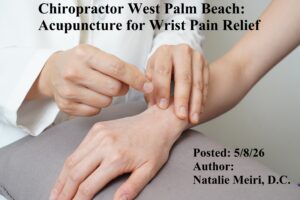
Chiropractor West Palm Beach: Acupuncture for Wrist Pain Relief.

This post is about Chiropractor West Palm Beach: Acupuncture for Wrist Pain Relief.

First, Your wrist is made up of eight small bones (carpal bones) plus two long bones in your forearm — the radius and the ulna. Your wrist functions as the link between the hand and the forearm. In your wrist, a tendon functions to move the bone. A ligament is a fibrous connective tissue that attaches bone to bone. There are no tendon attachments that function at the wrist. Tendons cross the wrist to insert into the hand, fingers, and thumb. Similarly, there are ligaments holding and stabilizing your wrist bones in place.

Second, Problems affecting muscles that originate off the elbow and forearm may show up as pain at your wrist. For example, Wrist conditions are often the result of trauma, overuse, and arthritis.

Third, in athletes, positions that strain muscles repetitively are likely to cause an insidious (gradual) onset. Ultimately, this may lead to tendonitis. Tendonitis is inflammation or irritation of a tendon. For instance, Weight lifting, gymnastics, rowing, and racquetball are culprits. Also, Overuse with typing is a common problem. Finally, You may be a professional musician or be in assembly line movement patterns at work.

Below are conditions causing Wrist Pain and 5 Tendonitises Acupuncture Can Help With

De Quervain’s Tenosynovitis

You will have radial (thumb side) wrist pain. It may happen after forceful gripping activities with ulnar deviation (bending the wrist to the little finger) or repetitive use of the wrist or thumb.

Cause:

A synovial tendon sheath surrounds your wrist tendon. This is a lubricated layer of tissue in which the tendon is housed and through which it moves. And stenosing tenosynovitis is inflammation of a tendon and its synovial sheath.  With de quervain’s tenosynovitis, two thumb muscles, the abductor pollicis longus (APL) and extensor pollicis brevis (EPB) tendons  at your wrist become stenosed.


Intersection Syndrome

You will have pain and crepitus (“creaky” joints) 2 inches above the wrist on the dorsoradial (back side, above thumb) aspect. This is usually after repeated wrist flexion (bending palm down) and extension (raising back of hand) movements with occupational or sports activities.

Cause:

An inflammatory response and possible bursitis occurs at the crossing of two groups of tendons: the abductor pollicis longus (APL) and extensor pollicis brevis (EPB) tendons crossing over the top of the wrist.  Bursae are fluid filled pads that act as cushions at the joints. Bursitis is inflammation of bursae. This occurs most often at joints that perform frequent repetitive motion. For example, Intersection syndrome is more common in canoeists, weight lifters, and recreational tennis players.


Other Tendinopathies of the wrist:


Extensor pollicis longus (EPL)tendinitis/tendinosis

This muscle arises dorsolaterally (back or upper surface) from the middle part of the ulna (long forearm bone closest to fifth finger) and ends at the distal (tip) of the thumb. The EPL extends the thumb (moves the thumb  away from the hand and parallel to the palm). For example, this tendonitis is seen in drummers, athletes involved in racquet sports, and patients with rheumatoid arthritis.


Extensor indices proprius (EIP) syndrome and extensor digiti minimi (EDM) tendinitis/tendinosis

The Extensor indices proprius (EIP) is a narrow, elongated muscle in the deep layer of the dorsal (back of ) forearm. Its tendon goes to the index finger, which it extends (bends backward).

The extensor digiti minimi (EDM) is also a narrow muscle which originates in the lateral humerus (elbow area) and attaches to your 5th digit (5th finger). The EDM is a two joint muscle. It acts as an extensor in both joints. The EDM extends the wrist and the little finger.  This means it moves the back of the hand toward the back of the forearm and straightens the little finger from a fist.


Extensor carpi ulnaris tendonitis/tendonosis

This muscle originates in the lateral humerus (elbow area). And it inserts into the 5th metacarpal (5th bone in palm of hand).  The extensor carpi ulnaris serves to extend and adduct the hand (moving a hand toward the body) at the wrist. On the whole, it is a relatively common tenonitis found in occupations or sports requiring repetitive wrist movement.  For example,this includes racquet sports, rowing, golf, and baseball.


Dr. Natalie Meiri
Dr. Natalie Meiri

How Does Acupuncture Work to Relieve Wrist Pain?

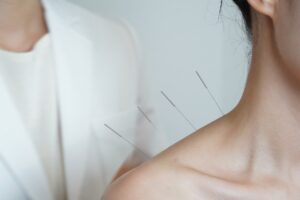
First, Acupuncture is a treatment that has been used for over 4000 years to treat pain and other health problems. Moreover, it is a painless technique used to affect what the ancient chinese practitioners called Meridians (energy channels) in your body under the skin.

Second, Traditionally, acupuncture is based on the belief that an energy, or “life force”, flows through the body in these channels called meridians. Also, this life force is known as Qi (pronounced “chee”).

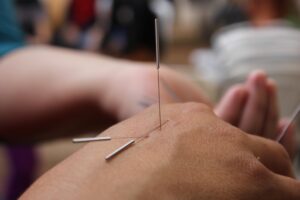
Third, Acupuncture Needles work by increasing the blood flow to the painful area, increasing and facilitating the flow of the “Qi”.  Subsequently, the goal is to activate the body’s natural healing abilities. Ultimately, it improves the function of your entire body.   

Fourth, the needle reduces the accumulated exudate (fluid that leaks out of blood vessels) at the site.  Additionally, it reduces inflammation, edema and increases joint movements.

 Chiropractor West Palm Beach: Acupuncture for Wrist Pain Relief Research

Firstly, in one study, with 622 participants Acupuncture proved effective and safe for short-term pain reduction and functional improvement in hand-and-wrist conditions.  For rheumatoid arthritis, 1 trial showed significant pain reduction and functional improvements post treatment and short-term. And in carpal tunnel syndrome, 1 trial showed significant pain reduction and functional improvements. In tenosynovitis, 1 trial showed significant pain reduction and functional improvements short-term. Also, for poststroke impairments, 1 trial showed significant functional improvements.

Secondly, in another study, stated acupuncture facilitates the blood flow, Qi flow and restores lost energy.  The treatment itself improves the general condition of the body. Furthermore, Acupuncture reduces inflammation, pain and improves joint movements.  According to traditional Chinese medicine (TCM), “if there is a blockage of the Qi flow, acupuncture can improve the Qi flow and blood flow to the body restoring lost energy”.


Chiropractor West Palm Beach: Acupuncture for Wrist Pain Relief

Acupuncture has a beneficial effect when treating many diseases and painful conditions. Meiri Chiropractic offers acupuncture for wrist pain and many other ailments. Dr. Natalie Meiri is a chiropractic physician, board certified in acupuncture with over 20 years of experience.   

Acupuncture is a holistic and natural way to treat existing injuries and disorders to keep your body in its best working condition.  Contact Meiri Chiropractic today at 561-253-8984 for your acupuncture treatment.


References:

Thomas Bergman, David Peterson, Chiropractic Technique Principles and Procedures, 3rd edition, 2011

https://pubmed.ncbi.nlm.nih.gov/35251436/

The Effect of Acupuncture on Hand and Wrist Pain Intensity, Functional Status, and Quality of Life in Adults: A Systematic Review

Kien Trinh  1   2 Fangwen Zhou  3 Nikita Belski  4 Jiawen Deng  3 Chi Yi Wong  3

PMID: 35251436 PMCID: PMC8886934  DOI: 10.1089/acu.2021.0046

https://www.researchgate.net/publication/336140902_Acupuncture_treatment_in_hand_and_wrist_pain

Acupuncture Treatment in Hand and Wrist Pain Jihe Zhu, Blagica Arsovska and Kristina Kozovska, International Journal of Current Advanced Research ISSN:O: 2319-6475, ISSN: P:2319-6505, Impact Factor 6.614


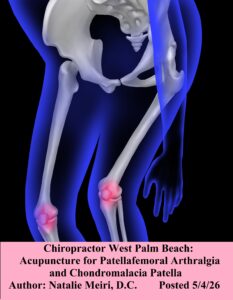
Chiropractor West Palm Beach: Acupuncture for Patellafemoral Arthralgia and Chondromalacia Patella

If you have Knee pain from Chondromalacia Patella, Acupuncture can provide relief! This post is about Chiropractor West Palm Beach: Acupuncture for Patellafemoral Arthralgia and Chondromalacia Patella.

You may have anterior (front) knee pain. However, your knee pain may be found behind, in and around your patella (knee cap) as well. It may be vague aching pain that is aggravated by going up and down stairs. Moreover, there may be associated crepitus (cracking or grating) and knee pain going through any squatting maneuver. 


 Anatomy

The patella (knee cap) is the largest sesamoid bone in the body. Sesamoid bones develop in some tendons where they cross the ends of long bones. The patella lies within the quadriceps muscle tendon. It functionally extends the lever arm for the quadriceps muscle.  It makes extension (straightening leg) of the knee much more effective. 

In addition, stabilization of the patella is provided by the quadriceps muscles, their fascial extensions, and the distal (end) attachment to the tibial tuberosity (boney bump on top of shin bone) via the patellar tendon. The distal (far from the body) end of the femur (thigh bone) and the proximal (nearest from the body) end of the tibia (shin bone) are connected by numerous ligaments and stabilized by strong muscles to form the knee joint. This joint is situated between the body’s two longest “lever arms”. Similarly, it must be able to transmit significant loads as it sustains high forces through upright posture and gait.

Three articulations (joints) are found in conjunction with the knee: the tibiofemoral, patellofemoral, and tibiofibular articulations. However, only the tibiofemoral and patellofemoral articulations participate in knee joint activity. The tibiofibular (fibula is the thin, outer long bone of the leg) articulation/joint does not actually contribute to the actions of the knee. Instead it is part of the ankle joint complex moving the ankle in all the various ranges of motion. However, dysfunctional processes in the proximal tibiofibular articulation/joint can affect other knee functions and can be a source of knee pain. 


Difference Between Patellafemoral Arthralgia/arthritis and Chondromalacia Patella

Certainly, biomechanical (study of living body) abnormalities can lead to an erosion and fragmentation of the sub patellar (beneath kneecap) cartilage.  This breaking up of the patella articular cartilage due leads to chondromalacia.  Apparently, many patellofemoral diagnoses are simply stages of the same overall etiology (cause of disease).

First, knee pain from chondromalacia is usually due to overuse injury while Patella femoral arthralgia is usually idiopathic (cause unknown).

Second, chondromalacia occurs on the medial facet (middle part) of the patella while patella femoral arthralgia occurs on the lateral facet (toward side) of the patella.  

Third, knee pain from chondromalacia occurs in mostly females less than 40 years old. Patella femoral arthralgia occurs in both female and males equally at a greater than 60 years of age.

Lastly, knee alignment in chondromalacia patella can be valgus (knock knee syndrome) or varus (bow leg syndrome).  However, the knee alignment is mostly valgus (bow leg syndrome) in patella femoral arthralgia. 

Causes of Knee Pain from Chondromalacia Patella

Firstly, patellofemoral syndrome is also called chondromalacia patella.  Additionally, it is called “runners knee” since it is common among runners.  Additionally, it is most frequently seen in teenagers, young adults, women and athletes.

Secondly, knee pain in chondromalacia is often related to maltracking or instability of the patella. So Patella tracking disorder (maltracking) describes a condition where movement of your kneecap isn’t aligned. Patella tracking problems can occur primarily from injuries to the knee and quadriceps mechanism.  The quadriceps are a group of four muscles that cover the front and sides of your thighs.  And it can secondarily be in response to problems affecting the ankle or hip.

  • There are many causes to the maltracking of the patella leading to knee pain in chondromalacia:
  • It may be secondary (happens after) to trauma and recurrent subluxation (dislocation).   
  • Postural problems, “Short leg syndrome”/ leg length inequality
  • Underdevelopment of the femoral condyles (rounded protuberance at the end of thigh bone) or the patella
  • Patella alta (high riding kneecap)
  • Imbalance in musculature for example in your quadriceps (group of muscles in front of thigh). Weak medial (toward middle) knee stabilizing muscles (Vastus Medialis Obliques, one of quadriceps) and tight lateral (toward side) muscles/structures such as the vastus lateralis (side quadriceps) and illio tibial band.
  • Excessive femoral torsion (inward twisting of the thigh bone) with resultant irregular “Q angle” (angle formed between the quadriceps muscles and the patella tendon).


How Does Acupuncuture Help Patellafemoral Arthralgia and Chondromalacia Patella from a Traditional Chinese Medicine (TCM) Point of View?

Traditional acupuncture is based on the belief that an energy, or “life force” called “Qi”, flows through the body.  According to Traditional Chinese Medicine (TCM), obstruction of qi and/or blood leads to pain. TCM theory says the Acupuncture treatment stimulates the imbalanced pathways along the meridians (energy channels). The goal is to activate the natural healing abilities of your body.

Furthermore, TCM theory says “obstruction” causes soreness, swelling, and stiffness to develop in your muscles and joints. Additionally, TCM says the obstruction can effect your entire body.  Therefore, TCM sees Chondromalacia Patella and patella femoral arthralgia as an “obstruction” called “bi” syndrome. 


Dr. Natalie Meiri
Dr. Natalie Meiri


Acupuncture Research on Knee Pain

Firstly, Researchers in one Study selected adults with chronic pain or osteoarthritis of the knee.  The adults received either acupuncture treatment or a control consisting of sham (placebo) acupuncture.  They found Acupuncture treatment is significantly superior to sham acupuncture. (1) It was  concluded, Acupuncture therapy helps knee arthritis. And Acupuncture promotes blood circulation of the knee joint and joint fluid circulation in the articular cavity. So it strengthens the nutrition of articular cartilage.

Secondly, in another study, the objective was to evaluate the effect of acupuncture in patellofemoral pain syndrome.  The study concluded that acupuncture may be a beneficial alternative treatment for patellofemoral pain syndrome. (2)

Chiropractor West Palm Beach: Acupuncture for Patellafemoral Arthralgia and Chondromalacia Patella

Meiri Chiropractic offers acupuncture for Patellafemoral Arthralgia and Chondromalacia Patella and many other ailments. Dr. Natalie Meiri is a chiropractic physician, board certified in acupuncture with over 20 years of experience.  Call today for your acupuncture treatment. If you have pain due to Chondromalacia Patella or other ailment, call us today at 561-253-8984! 


References:

(1) https://pubmed.ncbi.nlm.nih.gov/17215263/ Acupuncture treatment for chronic knee pain: a systematic review A White  1 N E FosterM CummingsP Barlas

(2) https://pubmed.ncbi.nlm.nih.gov/10630346/ Acupuncture treatment of patellofemoral pain syndrome

R Jensen  1 O GøthesenK LisethA Baerheim

Affiliations PMID: 10630346 DOI: 10.1089/acm.1999.5.521