Chiropractor West Palm Beach: Cervical Spine Anatomy and Chronic Neck Pain

Patient Satisfaction is found to be excellent for chiropractic care! Researchers analyzing the prevalence, patterns and predictors of chiropractic utilization in the U.S. general population found that, “Back pain and neck pain were the most prevalent health problems for chiropractic consultations and the majority of users reported chiropractic helping a great deal with their health problem and improving overall health or well-being.” (1) Chiropractor West Palm Beach: Cervical Spine Anatomy and Chronic Neck Pain is about how chiropractic can help chronic neck pain.


Symptoms of Cervical Spine (Neck) Pain

Symptoms  may only be stiffness or restricted range of motion.  Looking over the shoulder may not be possible. And/or moving the head in any direction may be difficult.  This came on insidiously for you.  Finally, It is painful and muscle spasm is present.

Common muscle imbalances at or affecting the cervical spine include tightness of the sternocleidomastoids (SCMs).  Also, short, deep neck extensors, upper trapezius, levator scapulae, and the pectoralis major and minor. Muscles can get inhibited (the nerve signals needed to activate and control the muscle are impaired, leading to weakness and poor function).  These include the deep neck flexors.  Also, the lower stabilizers of the scapulae, including the lower and middle trapezius and the rhomboids are involved. In the end, these imbalances often lead to a rounded shoulder-forward head position.
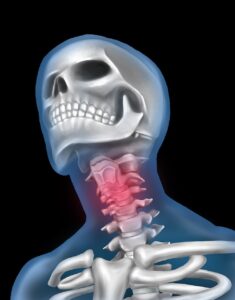
 

Relevant Cervical Spine Anatomy

Firstly, the cervical spine can be divided into 2 sections when describing the anatomy. The first section is the upper cervical spine consisting of the occiput (bottom of skull) and CI-C2.  The second section would be the lower cervical spine (C2-C7/TI). Functionally, there is a distinction between these two sections due to the greater degree of rotation at the upper cervical spine. So the unique articulation between the C2 and C1 vertebrae allow this greater rotation.  Specifically, the dens of C2 is the pivot for rotation.  Additionally, there is more lax ligamentous structures in this area.  Therefore, the muscles are more supportive and intricate so as to provide the stability and control. Indeed, this area has more laxity in the ligamentous system than the thoracic (mid back) and lumbar (low back) spine.

Secondly, another difference in the upper cervical spine is there is no disc between and C0, C1 and C2 levels.  Discs, called intervertebral discs, are positioned between each vertebra throughout the rest of the spine.

Thirdly, neurologically, the upper cervical spinal cord has a unique connection with the central nervous system.   This is through the trigeminocervical nucleus (functional convergence zone in the upper cervical spinal cord where sensory nerve fibers from the face (via the trigeminal nerve) and the upper neck (C1-C3 spinal nerves) meet. Here there is an intermingling of the spinal nucleus of the trigeminal nerve and the dorsal horn of the upper cervical spinal nerves. This is an anatomical explanation for the cause of headaches, dizziness, and facial pain.


Chiropractor West Palm Beach: Cervical Spine Anatomy and Chronic Neck Pain Connection…

The cervical spine has the task of maintaining head posture while allowing for a great deal of mobility. Moreover, the cervical spine must balance the weight of the head atop a relatively thin and long lever. This makes it quite susceptible to traumatic forces. The cervical facets (paired joints in neck) allow movement in all directions. In fact, the cervical spine is therefore the most movable portion of the spine. Anatomically, it is quite vulnerable.


Causes of Neck Pain from Daily Stresses

Incorrect posture, obesity and weak abdominal muscles often disrupt spinal alignment. This leads your neck to bend forward to compensate. Stress and emotional problems can cause muscles to tighten and contract, resulting in pain and stiffness. Postural stress can contribute to chronic neck pain. Symptoms can eventually extend into the upper back and the arms.

Dentists, mechanics, plumbers, electricians, and various technicians can be in awkward positions for prolonged periods. Any particular position may cause pain.  So many neck structures can be stretched or compressed.

There are repetitive sports injuries to the neck.  These may become chronic due to lack of proper treatment.

Research For Neck Pain Relieved by Chiropractic Care

There was a recent study funded by NIH’s National Center for Complementary and Alternative Medicine.  It was to test the effectiveness of different approaches for treating mechanical neck pain. 272 participants were divided into groups.  They received either spinal manipulative therapy (SMT) from a doctor of chiropractic (DC) or pain medication. It lasted for 12 weeks.  About 57 percent of those who met with DCs reported at least a 75 percent reduction in pain.  In comparison, only 33 percent of the people in the medication group reported pain reduction. After one year, approximately 53 percent of the drug-free groups continued to report at least a 75 percent reduction in pain. And this compared to just 38 percent pain reduction among those who took medication.


Chiropractor West Palm Beach: Cervical Spine Anatomy and Chronic Neck Pain

Dr. Natalie Meiri will examine you and come up with a treatment plan to get you better! Through regular chiropractic visits, you can get pain relief and improve your health without drugs or surgery. Indeed, although aging is a slow and progressive deterioration of bodily functions the body can be maintained by proper care.

Make an appointment today at 561-253-8984! And/or call to find out more about Chiropractor West Palm Beach: Cervical Spine Anatomy and Chronic Neck Pain.

References: (1 ) Adams et al (2017) Spine

                   (2) Bronfort et al. (2012), Annals of Internal Medicine


From Dr. Natalie Meiri’s clinical pearl story about Chiropractor West Palm Beach: Relief From Hip Osteoarthritis With Acupuncture


This is my clinical pearl story about Chiropractor West Palm Beach: Relief from Hip Osteoarthritis With Acupuncture.  He was a 49 year old male patient.  His chief complaints were right hip pain. To be HIPAA compliant, I will call him Brett instead of his real name.

Brett’s right hip was chronically hurting now for over a year. And Brett even had thigh pain from  sudden movement. It had come on insidiously and seemed to be getting worse day by day. Brett may have had some trauma or injury involving his hip in the past. However, it always seemed to subside.

At first, Brett thought his pain was in the low back or buttocks when it was in fact due to his hip.  He had seen his primary care physician and had his hip and low back x-rayed.  The pain medication his primary prescribed didn’t help at all.  So that’s when he decided to try acupuncture.


Brett’s Examination at Meiri Chiropractic

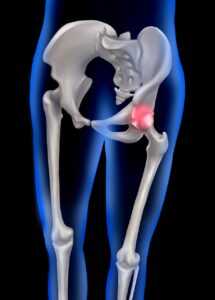
Upon examination, Brett tested positive for his right hip condition.  His x-rays taken at the primary care doctor showed degenerative arthritis (osteoarthritis). Indeed, as a weight bearing joint, the hip is commonly affected by degenerative joint changes and soft tissue damage.   Brett’s diagnosis was osteoarthritis of his right hip. If Brett wasn’t responding in a month, further testing (e.g. MRI) would be ordered.


Hip Anatomy

The hip, like the shoulder, is considered a ball-and-socket joint. It is formed by the head of the femur (thigh bone) which sits in what’s called the acetabulum, a part of the pelvis. The head of the femur is large (ball) and the acetabulum (socket) is deep.  The soft tissues (refers to non-bony structures that connect, support, or surround other structures) in your hip are:

  • the muscles, which allow you to move.
  • the tendons, which connect your muscles to the bone.
  • the ligaments are bands of tough elastic tissue around your joints. They connect bone to bone, give your joints support, and limit their movement.
  • the fascia – stretchy, thin, white fibrous tissue. All your muscles are enveloped in fascia.
  • the bursae – fluid-filled pads that act as cushions at the joints. Bursae reduce friction between the surfaces of a bone and soft tissue 

What is Osteoarthritis?

Primary Osteoarthritis occurs usually in middle-aged to elderly people (>45 years old). It is more prevalent in women (female to male 10:1). Primary means this osteoarthritis develops due to aging and the wear and tear that comes along with it.

An example would be Brett’s hip: primary femoroacetabular (hip) osteoarthritis. Typically, your symptoms consists of hip and possibly buttock, groin, or knee pain that was insidious (came on gradually) in onset. Additionally, you note a slow stiffening, specifically internal (inward) rotation. This often results in walking with the hip held in external (outward) rotation. You may complain of low back pain due to excessive extension with weight bearing. The low back pain is really due to compensating for limited hip movement due to hip osteoarthritis.

Common joints involved in primary osteoarthritis are the hips, knees, sacroiliac joint, acromioclavicular (shoulder and collar bone), first metacarpophalangeal (part of thumb joint), first metacarpotrapezium (part of thumb joint closer to wrist), and the distal interphalangeal joints (joints at tips of fingers).

Often initially asymptomatic, you will have a gradual increase in joint stiffness and pain. Moreover, deformity may be apparent such as  herberden’s nodes in the hands (bony bumps).  If not treated, primary osteoarthritis may eventually lead to joint subluxation (dislocation) and instability.

Cause of Osteoarthritis

Primary osteoarthritis is due to progressive degeneration of the joint or joints involved by an accumulation of microtrauma.  A microtrauma is an injury resulting from repetitive stress to tissues. 

Chiropractor West Palm Beach: Relief From Hip Osteoarthritis With Acupuncture


Brett’s Acupuncture Treatments at Meiri Chiropractic


Brett did a course of acupuncture treatments (1-2 times a week for 12 weeks).  

His acupuncture treatments consisted of the insertion of very thin metal needles.  These were inserted into the skin and underlying tissues. 

Brett reported that he was starting to feel better after the initial visit.  Moreover, he continued to improve with each visit. After 12 visits, he was mostly pain-free.  Brett continued his acupuncture treatments thereafter at less frequent intervals.


How Does Acupuncture Help Hip Osteoarthritis?

Firstly, a study published in the JAMA Internal Medicine was done to determine the effect size of acupuncture for 4 chronic pain conditions: back and neck pain, osteoarthritis, chronic headache, and shoulder pain.  The study concluded: Acupuncture is effective for the treatment of chronic pain and is therefore a reasonable referral option.

Secondly, research studies have shown promising results for the use of acupuncture to manage arthritis symptoms.  However, limitations in study design and sample size suggest that further research needs to be done. More studies to better understand the impact of acupuncture on arthritis pain and inflammation is being done.  Nevertheless, with existing evidence and because acupuncture carries a low risk of harm, acupuncture is recommended for people with arthritis.

Thirdly, Acupuncture in combination with a chiropractic care plan may help dramatically to reduce pain and improve quality of life.

Fourthly, Neuroscientists at Harvard Medical School looked at the underlying neuroanatomy of acupuncture.  Specifically, that acupuncture activates a nerve signaling pathway. The signaling affects the function of other parts of the body, including organs (and neuromusculoskeletal body parts).

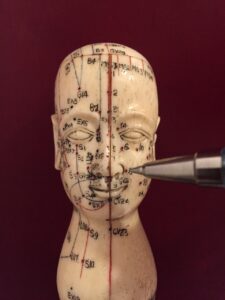
Fifthly, Acupuncture has been used for over 4000 years to treat pain and other health problems safely and effectively. The acupuncture treatment stimulates the imbalanced pathways called meridians. This activates the body’s natural healing abilities.  Ultimately, this brings balance back to your body. Indeed, Acupuncture has a beneficial effect when treating many diseases and painful conditions.


Dr. Natalie Meiri
Dr. Natalie Meiri


Chiropractor West Palm Beach: Relief From Hip Osteoarthritis With Acupuncture

Meiri Chiropractic offers acupuncture for hip osteoarthritis and many other ailments. Dr. Natalie Meiri is a chiropractic physician, board certified in acupuncture with over 20 years of experience.  Call today for your acupuncture treatment for hip osteoarthritis at 561-253-8984.


References: Acupuncture for Chronic PainIndividual Patient Data Meta-analysis

  1. Andrew J. Vickers, DPhil; Angel M. Cronin, MS; Alexandra C. Maschino, BS
  2. et al  https://jamanetwork.com/journals/jamainternalmedicine/fullarticle/1357513

Chiropractor West Palm Beach: Relief from T.M.J. Pain With Acupuncture


From Dr. Natalie Meiri’s clinical pearl stories: Chiropractor West Palm Beach: Relief from T.M.J. Pain with Acupuncture


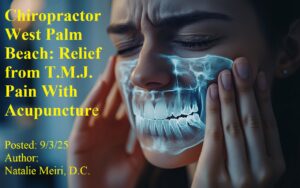
This is my clinical pearl story about Chiropractor West Palm Beach: Relief from T.M.J. Pain With Acupuncture.  She was a 45 year old female patient.  Her chief complaint was temporomandibular joint (T.M.J.) pain.   To be HIPAA compliant, I will call her Gene instead of her real name.

Gene had suffered from T.M.J. pain for a year. Gene stated her T.M.J. pain was from grinding her teeth from stress.  She felt the pain in her jaws and face.  Additionally, her symptoms included clicking, popping, or grinding noises in the jaw.  Furthermore, at times she had some difficulty opening or closing the mouth. Gene felt Jaw “stiffness or locking”. Moreover, she even felt ear pain and/or fullness along with mild dizziness and headaches.

However, since she was perimenopausal she felt her hormones were causing some of her issues of aches and pains. Also, she wasn’t sleeping well.

Before Gene came to see me, she went to her dentist.  He gave her a (mouth guard) splint and a prescription for NSAIDS (nonsteroidal anti-inflammatory drugs). Gene’s dentist told her she “grinds her teeth”.  By his recommendation, she tried a splint at night which helped a little.  

Finally, Gene came to see me since she still had TMJ pain.


Temporomandibular Joint (TMJ) Anatomy

The TMJ is composed of:

Synovial cavity– space between the bones in a synovial joint that’s filled with synovial fluid (nourishing thick fluid).

Articular cartilage– specialized type of connective tissue that covers the ends of bones in joints.  It provides a smooth surface for joint movement.

-Articular capsule– fibrous connective tissue encloses the joint capsule

Several ligaments- ligament is a band of tissue that connects bones and joints. Ligaments hold the TMJ in place and help move it properly.

Disk- articular fibrocartilaginous structure located between the mandible (jaw bone) and the temporal bone (sides of skull).

TMD refers to a group of disorders affecting the temporomandibular joint (TMJ), the joint connecting the jaw to the skull.


Temporomandibular Joint (TMJ) Pain/ Temporomandibular diseases (TMD) and Causes


Temporomandibular diseases (TMD) refers to a group of disorders affecting the temporomandibular joint (TMJ), the joint connecting the jaw to the skull.

TMJ problems can be due to developmental abnormalities, intracapsular diseases, and dysfunctional conditions:

-Developmental abnormalities include hypoplasia/hyperplasia (under or over development of TMJ)

-Impingements (pinching) of the various TMJ structures (e.g. coronoid process, synovial fold)

-Ossification (calcification) of TMJ ligaments (e.g. stylohyoid ligament; Eagle syndrome).

-Intracapsular (located within a capsule) diseases (e.g. disk adhesions/displacements, degenerative arthritis, rheumatoid arthritis, psoriatic arthritis, infections, and gout)

– Postural stresses, muscle tone, malocclusion/dysfunction of the teeth can affect the TMJ.

-Women experience a higher incidence of oral (mouth) diseases including periodontal diseases and temporomandibular joint disease/pain. This points to the role of estrogen on TMJ structures.  Low levels of estrogen during menopause predisposes the TMJ to degeneration (osteoarthritis).  Furthermore, it leads to alveolar (bony ridge that contains the sockets of the upper teeth) bone loss.


Chiropractor West Palm Beach: Relief from T.M.J. Pain with Acupuncture-Gene’s Examination

Upon examination, Gene’s mandibular “gait” (way lower jawbone moves) was out of alignment.   Tendinitis and trigger points were found by increased tenderness in the belly and tendons of the masseter (muscles on mandible that help close the mouth) and temporalis (muscle on temporal bone that help move jaw bone).  Plain film x-rays are virtually useless for TMJ disorder diagnosis (except perhaps for fracture).  And since there was no history of trauma, x-rays were not performed. Gene would try a course of 12 acupuncture treatments. 


Chiropractor West Palm Beach: Relief from T.M.J. Pain with Acupuncture-Gene’s Acupuncture Treatments

Gene’s Acupuncture treatments consisted of the insertion of very thin metal needles.  These were inserted into the skin and underlying tissues of the appropriate acu points.  Her sleep and stress issues were also addressed through acupuncture. The outcome for Gene was pain relief and improved T.M.J. function.  Gene symptoms of temporomandibular diseases (TMD) was resolved.She also stated, “more energy, better sleep and less stress” with her treatments!


How Does Acupuncture Help T.M.J. Pain, Disorders and Dysfunction?

Firstly, in one study (1), they utilized Acupuncture’s effectiveness for pain relief and muscle relaxation. They looked at the possibility of acupuncture treatment altering the the occlusal forces and mandibular movements in patients with deep-bite malocclusion (overbite). The study confirmed that acupuncture may become an alternative treatment on improving the occlusal force of deep-bite patients.

Secondly, a study (2) at the TMD Clinic, at the School of Dentistry, The University of Manchester was done.  It compared the effect of real acupuncture and sham acupuncture in the treatment of temporomandibular joint myofascial pain.  This was to establish the true efficacy of acupuncture.  The “results demonstrated that real acupuncture had a greater influence on clinical outcome measure of TMJ myofascial pain than those of sham acupuncture”.

Thirdly, Neuroscientists at Harvard Medical School looked at the underlying neuroanatomy of acupuncture.  Specifically, that acupuncture activates a nerve signaling pathway. The signaling affects the function of other parts of the body, including organs (and neuromusculoskeletal body parts).


Dr. Natalie Meiri
Dr. Natalie Meiri


Chiropractor West Palm Beach: Relief from T.M.J. Pain with Acupuncture

Acupuncture has been used for over 4000 years to treat pain and other health problems safely and effectively. The acupuncture treatment stimulates the imbalanced pathways called meridians. This activates the body’s natural healing abilities.  Ultimately, this brings balance back to your body. Indeed, Acupuncture has a beneficial effect when treating many diseases and painful conditions.

Meiri Chiropractic offers acupuncture for T.M.J. Pain and many other ailments. Dr. Natalie Meiri is a chiropractic physician, board certified in acupuncture with over 20 years of experience.  Call today for your acupuncture treatment for T.M.J. Pain and Dysfunction at 561-253-8984.


References:

  • (1) Effects of short-term acupuncture treatment on occlusal force and mandibular movement in patients with deep-bite malocclusion J Dent Sci . 2019 Mar;14(1):81-86. doi: 10.1016/j.jds.2018.11.003. Epub 2018 Dec 4. Chih-Yu Fang, Jian-Hog Yu, Chia Chi Chang, Jhia Chi Chang, Jui Ting Hsu, Yu Chen Lee Heng Li Huan 


  • (2) The efficacy of acupuncture in the treatment of temporomandibular joint myofascial pain: a randomised controlled trial PHilip Smith, Daniella Mosscrop, Stephen Davies, Philip Sloan, Ziad Al-AniAffiliations  PMID: 17095133 DOI