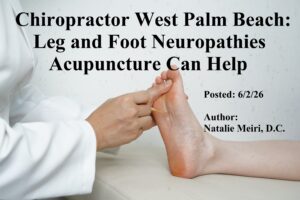
This post is about Chiropractor West Palm Beach: Leg and Foot Neuropathies Acupuncture Can Help (Part 1). Peripheral Neuropathy is a general term for when there is damage to the peripheral nerves. And Peripheral nerves connect your brain and spinal cord to the rest of your body. Neuropathy can be caused by various disorders and dysfunctions (e.g nerve entrapment, diabetes). Fortunately, if you have peripheral neuropathy of the leg or foot, acupuncture can provide relief! We’ve got some great information to share below about Peroneal Nerve Entrapment/Neuropathy and how Acupuncture can Help.
Peroneal Nerve Entrapment and Neuropathy
Do you have pain and burning over the outer border of the distal (closest to foot) calf and dorsum (top) of the foot and ankle? Perhaps you also have numbness and paresthesia (pins and needles)? These are all symptoms of superficial peroneal nerve entrapment and neuropathy.
Ankle/Foot Pain Due to Superficial Peroneal Neuropathy
If you are exercising, you may experience a loss of sensation or pain along the lateral calf. Additionally, swelling may occur locally in your foot. At other times, the pain may localize to a distal part of your leg.
Common Peroneal Nerve versus the Superficial Peroneal Neuropathy
Injury to the common peroneal nerve results in a foot drop described as slapping or tripping. Pain and parethesia (pins and needles) may occur at the site of compression as well as distally into the lateral leg. At times there may be a radiation of pain into the thigh. Numbness and tingling can occur along the lateral leg and dorsum (upper surface) of the foot. Peroneal neuropathies occurring at the fibular (outer of two bones of the lower leg) neck (upper part of fibula) affect the DPN (deep peroneal nerve). The SPN (superficial peroneal nerve) entrapment occurs in the lower leg at the ankle frequently due to a twisting of the ankle.

Chiropractor West Palm Beach: Leg and Foot Neuropathies Acupuncture Can Help (Part 1): Causes
Runners involve the superficial peroneal nerve frequently due to repetitive stretching. This happens during inversion (turning sole of foot inwards) and plantar flexion (turning foot towards sole of foot), causing the nerve to push up against the fibula neck (top part of outer of 2 leg bones).
You may have had a lateral (side) ankle sprain. This may have also stretched and damaged the superficial peroneal nerve at the level of the fibular head (top of side leg bone). Similarly, a previous problem with this nerve may create a weakened peroneal muscle. And the peroneal muscle is essential for ankle positioning (especially for inversion) and stability. Next, this results in recurrent ankle sprains.
Other causes may be:
-prolonged knee crossing (especially if you have recently lost a large amount of weight)
-tight knee band or cast
-repetitive trauma
-ganglions, cysts, or tumors
Anatomy of the Superficial Peroneal Nerve
Firstly, the superficial peroneal nerve originates from the common peroneal nerve along with the deep peroneal nerve. The superficial peroneal nerve is the smaller of the two common peroneal nerve branches.
Secondly, the common peroneal nerve arises from spinal nerves L4 through S1. Furthermore, the common peroneal nerve branches out from the sciatic nerve, which is composed of fibers from spinal nerves L4 through S3.
Third, the sciatic nerve terminates at the popliteal fossa of the knee. It divides into the common peroneal and tibial nerves as it wraps around the top of the fibular bone.
Fourth, after separating from the common peroneal nerve, the superficial peroneal nerve courses through the peroneus longus muscle. The superficial peroneal nerve provides motor stimulation to the peroneus longus and peroneus brevis muscles (group of muscles that run along the outside of the lower leg and attach to the bones of the foot).
Fifth, the superficial peroneal nerve leaves the peroneal muscles on the anterolateral (front and side) aspect of the lower leg above the ankle joint.
Sixthly, the medial and intermediate dorsal cutaneous nerves appear from the superficial peroneal nerve. And these nerves provide sensory innervation to the leg’s anterolateral aspect, the dorsum (top) of the foot, and the dorsal (top) aspect of the toes, except the 1st interdigital space (between toes), which is innervated by the deep peroneal nerve.
Chiropractor West Palm Beach: Leg and Foot Neuropathies Acupuncture Can Help -Examination
Typically, patients are diagnosed by the physical (orthopedic, neurological etc.) examination. However, your doctor may order a nerve conduction study in a difficult unremitting case. Often, you may also need an x-ray.
Sites of possible entrapment of the superficial peroneal nerve include the following:
-deep fascia of leg, extensor digitorum longus muscle
-extensor hallucis longus muscle (lower leg muscles that move the foot and big toe)
-superior and inferior extensor retinaculum (thickened fascia located at the ankle joint).

Research on Acupuncture for Superficial Peroneal Nerve Pain and How it Works
Firstly, one review aimed to assess the efficacy of acupuncture in the treatment of neuropathy of various etiologies (cause). Acupuncture appears to improve nerve conduction study parameters in both sensory and motor (movement) nerves. A nerve conduction study (NCS) is a diagnostic test that measures how fast and effectively electrical signals travel through your nerves. So this study focused on acupuncture and it’s effects on nerve function.
Secondly, traditional Chinese Medicine’s explanation is that channels of energy called meridians run in regular patterns through the body and over its surface. These energy (called Qi) channels, nourish the tissues. Moreover, with acupuncture treatment, there is an improvement and balance of energy. Ultimately, this results in stimulating the body’s natural healing abilities. Lastly, it promotes physical and emotional well-being.
Thirdly, the modern scientific explanation is that needling the acupuncture points stimulates the nervous system. Ultimately, this releases chemicals (e.g. enkephalins and endorphins) in the muscles, spinal cord, and brain. These chemicals can dramatically relieve pain. Also, they will trigger the release of other chemicals and hormones. And this further influences the body’s own internal regulating system.
Fourthly, once these neurotransmitters are moving about, your blood vessels vasodilates. And this gets blood into the affected areas, initiating healing. Indeed, Acupuncture improves blood flow and calms the nervous system.
Are your suffering from leg, ankle and/or foot pain from Neuropathy?
Meiri Chiropractic offers acupuncture for superficial peroneal nerve pain and many other ailments. Dr. Natalie Meiri is a chiropractic physician, board certified in acupuncture with over 20 years of experience. Call 561-253-8984 today! Ask to make an appointment or find out more about: Chiropractor West Palm Beach: Leg and Foot Neuropathies Acupuncture Can Help (Part 1). The next post will be on leg, ankle and/or foot pain involving the Sural Neuropathy/Nerve Entrapment.
References:
https://pmc.ncbi.nlm.nih.gov/articles/PMC5359694/
J Altern Complement Med. 2017 Mar 1;23(3):164–179. doi: 10.1089/acm.2016.0155
Acupuncture for the Treatment of Peripheral Neuropathy: A Systematic Review and Meta-Analysis